Is Product Hunt worth it? 2025–2026 launch and failure data
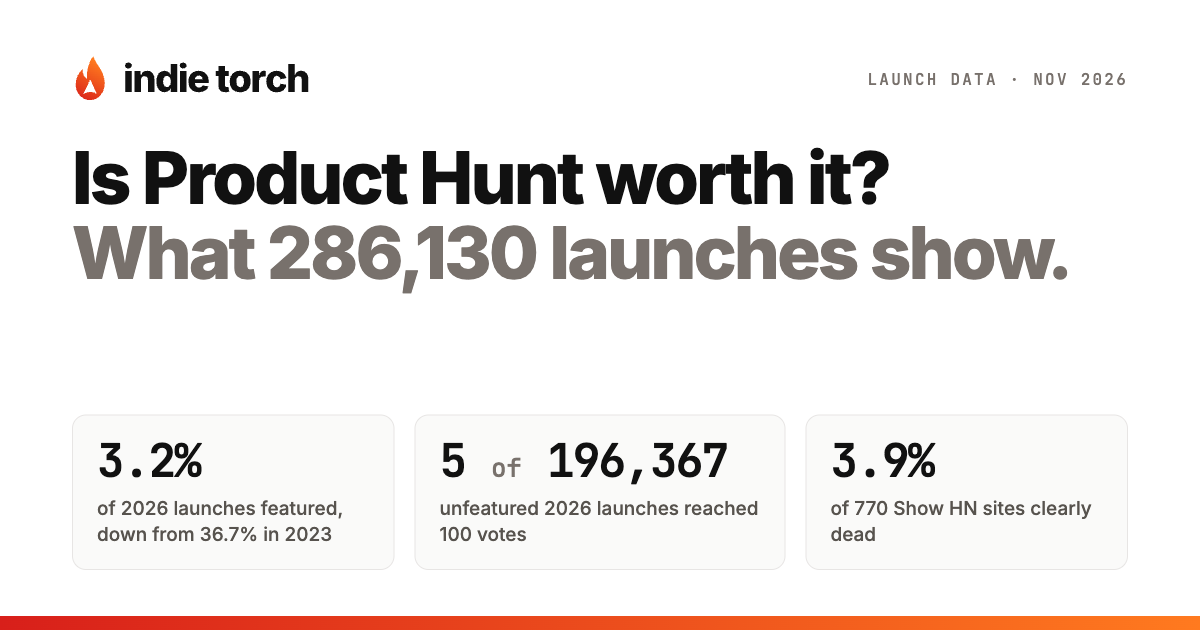
Product Hunt featured 3.2% of 2026 launches, and 5 of 196,367 unfeatured ones reached 100 votes. Data from 286,130 launches and 770 Show HN sites.

Lourdes Paul Agilan
On this page
- Key findings
- How many products launched
- Is Product Hunt worth it? What the numbers can and can’t tell you
- How we measured failure
- What the sample shows
- Is SaaS dead with AI? What this data shows
- Traction and survival: how to get first users
- Why founders say they shut down
- Industry context (different populations)
- Caveats
- FAQ
- Is Product Hunt worth it?
- How many products launch on Product Hunt each year?
- How many Show HN posts are there?
- What percentage of launch-platform startups fail?
- Is a startup dead if its website is live?
- Cite this research
- Sources
Short answer: our data can’t tell you what a launch earns you, but it does show how little attention an unfeatured Product Hunt launch gets. Product Hunt featured only 3.2% of 2026 launches (36.7% in 2023), and just 5 of 196,367 unfeatured 2026 launches reached 100 votes. We also checked 770 Show HN product sites on 10 November 2026, and 3.9% were clearly dead. Details and caveats follow.
Between January 2025 and late 2026, Product Hunt and Show HN took in a huge number of launches. Dead websites didn’t keep pace. A live landing page doesn’t mean a living business, and most 2026 launches haven’t had time to disappear.
This report covers how many products launched, how many sampled sites were clearly dead on 10 November 2026, and why founders say they shut down.
Disclosure: Indie Torch runs a weekly launch platform, so we compete with the boards in this report. Every figure comes from the public sources listed at the end or from our own check of public Show HN links. Nothing here measures Indie Torch.
Key findings
- 286,130 Product Hunt launches from January 2025 to 27 October 2026 (GTM for One’s API count).
- 72,129 Show HN posts from January 2025 to October 2026 (Hacker News Algolia index, stories tagged
show_hn). - 3.9% of sampled Show HN product sites were clearly dead: 30 of 770 (95% Wilson interval: 2.7% to 5.5%).
- 4.8% vs 2.9%: 20 of 420 sites from 2025 launches, against 10 of 350 from 2026 launches.
- Product Hunt’s featured share dropped from 36.7% of launches in 2023 to 3.2% in 2026.
- 6 of 12 founder post-mortems blamed AI tools or platforms absorbing what the product did.
- Treat 3.9% as a minimum for failure, not a full count of dead companies.
How many products launched
GTM for One’s Syed Asif Sultan pulled every launch from Product Hunt’s public GraphQL API from 1 January 2022 through 27 October 2026, 399,558 launches in all. hunted.space Pulse, a third-party tracker, comes close on 2025 and on 2026 monthly totals.
| Year | Launches | Featured | Share featured | Unfeatured that reached 100 votes |
|---|---|---|---|---|
| 2022 | 29,155 | 10,464 | 35.9% | 6 of 18,691 |
| 2023 | 40,887 | 15,020 | 36.7% | 19 of 25,867 |
| 2024 | 43,386 | 7,265 | 16.7% | 57 of 36,121 |
| 2025 | 83,218 | 5,209 | 6.3% | 53 of 78,009 |
| 2026 (to 27 Oct) | 202,912 | 6,545 | 3.2% | 5 of 196,367 |
On a typical 2026 day, about 676 products launched on Product Hunt, while featured spots stayed near 22 a day. The homepage and the stream of new submissions have become two different places.
A few other counts, each from a different source:
- Vibe Your SaaS counted 80,791 Product Hunt launches in 2025, including 31,590 AI-tagged products. It tags AI differently than GTM, whose count puts AI at roughly 29% of launches since 2023.
- hunted.space lists October 2026 (21,633 launches), July 2026 (21,487) and June 2026 (21,039) as the busiest months on record. Its published 2026 total of 189,478 looks out of date, since its own monthly figures already add up to about 200,174 for January through October. We used GTM for One for totals.
- Show HN had 30,270 posts in 2025 and 41,859 from January to October 2026. February 2026 was the peak month at 6,217. That matches Submitium’s February peak and sits close to Submitium’s 40,874 posts for 1 January to 24 October 2026 (our count runs through 31 October). Submitium found that 61% of 2026 Show HN posts got 2 points or fewer, and 1.6% reached 100 points.
- LaunchAmp recorded a median of 24 launches a day on Uneed over 175 days. A founder scraped about 1,500 DevHunt launches and saw growth from roughly 150 a month in early 2024 to 500-plus by late 2025, though that isn’t a full count. We found no reliable 2025–2026 count for Peerlist or BetaList.
Is Product Hunt worth it? What the numbers can and can’t tell you
Our data doesn’t measure what a launch pays back: no traffic, no signups, no revenue. It does show how concentrated attention has become.
- In 2023, Product Hunt featured 36.7% of launches. In 2026, it featured 3.2%.
- A typical 2026 day brought about 676 launches and about 22 featured spots.
- Among unfeatured launches, 53 of 78,009 reached 100 votes in 2025. In 2026 to 27 October, 5 of 196,367 did.
If your launch isn’t featured, your Product Hunt page is mostly a listing. Whether that’s worth it depends on what you want from it: a permalink and a badge, or a traffic spike. Weighing other boards? Our free list of SaaS directories includes 110 launch and startup platforms. Indie Torch takes a different route, with one launch week at a time and a capped number of slots; how launch weeks work explains it.
How we measured failure
Product Hunt’s public pages sit behind Cloudflare, and we used no Product Hunt developer token or account for this run. So we sampled Show HN, a major launch board with a complete public index of product URLs.
- Sample: for each month from January 2025 through October 2026, we drew 35 posts at random (seed 20261110) from posts that linked to a product site: an own domain, a shared host such as Vercel or Netlify, or GitHub Pages. We excluded GitHub repositories, blog platforms, app stores and social links. That gave us 770 URLs (35 × 22 months).
- Check: we fetched each URL over HTTPS with a 9-second timeout on 10 November 2026 at 10:44 AM IST.
- Strict failure (clearly dead): DNS or host unreachable, HTTP 404 or 410, a parked or for-sale page, or copy that reads like a shutdown notice.
- Loose failure: strict failures plus timeouts, TLS errors, connection failures and HTTP 5xx errors. We treated 403s and similar blocks as probably alive.
- Second sample: 476 Product Hunt products with 2025 launch dates from the Hugging Face dataset
pranavjrat/top_producthunt_products. It catalogs notable products rather than a random draw, and it has no 2026 rows, so its death rate leans toward survivors.
At least one automated shutdown flag was wrong: saturnsql.com writes about other products shutting down.
What the sample shows
| Result | Sites | Share of 770 |
|---|---|---|
| Live (200–399 response) | 609 | 79% |
| TLS error | 95 | 12% |
| Other (block, 5xx, timeout) | 36 | 5% |
| Clearly dead | 30 | 4% |
The strict dead rate is 30 of 770, or 3.9% (95% Wilson interval 2.7% to 5.5%).
| Launch group | Sample | Clearly dead | Strict rate | Loose rate |
|---|---|---|---|---|
| Show HN 2025 | 420 | 20 | 4.8% | 28.8% |
| Show HN 2026, Jan to Oct | 350 | 10 | 2.9% | 7.7% |
| Show HN, all | 770 | 30 | 3.9% | 19.2% |
| Product Hunt top-product catalog, 2025 | 476 | 18 | 3.8% | 14.9% |
Age matters. The 2025 group has 10 to 22 months of follow-up, and none of the 35 sites sampled from October 2026 were strictly dead.
TLS errors track site age more sharply than 404s do. 81 of 420 sites from 2025 (19%) had a TLS error, against 14 of 350 from 2026 (4%). Expired certificates often show up on neglected sites before the domain drops. A TLS error signals neglect. It doesn’t prove a shutdown.
The Product Hunt catalog leans toward notable products, yet its strict rate is similar: 18 of 476, or 3.8%. Several of those 18 are broken links, like a moved Google DeepMind page or missing app-store listings, rather than indie shutdowns.
Is SaaS dead with AI? What this data shows
Two findings point in different directions.
Dead-site rates show no AI-wrapper wipeout yet. AI-titled Show HN posts died at 9 of 232 (3.9%), the same rate as non-AI posts at 21 of 538 (3.9%).
Founders still name AI as their top reason for quitting. Six of the 12 public post-mortems from 2025 and 2026 said AI tools or platforms absorbed what the product did:
“ChatGPT and other tools caught up. My value prop was really time savings. A user could make an article in 20 seconds instead of a few hours. They could make the same article in 10-20 minutes with ChatGPT.”
John Ward, Content Goblin (launched about January 2025, shut July 2025)
“Context windows went from 8K tokens to 128K to 1 million. … The constraint we were solving for has been absorbed by the infrastructure itself.”
Navigable AI (shut 31 August 2026 after about two years)
SimpleClosure reports that AI companies made up 14.4% of the closures it handled in H1 2026, against 27.3% for B2B SaaS. Its own reading is that many 2026 closures are pre-AI SaaS companies reaching the end of a 2022-era runway, rather than a wave of newborn AI wrappers. The median AI company it closed was 2.30 years old, against 3.78 for non-AI companies.
The two findings are compatible. Products launched in 2026 mostly haven’t had time to die in public, and founders who have shut down most often name AI tools or platforms absorbing the product.
Traction and survival: how to get first users
None of the 18 Show HN posts that reached 100 points had a clearly dead site on check day.
| Show HN points | Clearly dead |
|---|---|
| 1 to 4 | 4.5% (27 of 605) |
| 5 to 9 | 2.3% (2 of 88) |
| 10 to 99 | 1.7% (1 of 59) |
| 100 or more | 0% (0 of 18) |
Posts stuck at 1 to 4 points make up most of the sample and 27 of the 30 deaths. Only 18 posts hit 100 points, so treat this as a hint, not a law: launches nobody notices disappear from the web faster. For what to do around a launch, see our launch checklist and the launch guide.
Why founders say they shut down
We read twelve public post-mortems from 2025 and 2026, in full or in reliable excerpts. Founders usually name more than one cause, so the counts overlap. These aren’t a random sample of shutdowns. They’re the stories founders chose to write.
| Reason | Post-mortems |
|---|---|
| AI tools or platforms absorbed the product | 6 |
| No market need or weak product-market fit | 4 |
| No distribution or not enough users | 4 |
| Founder choice, burnout or next chapter | 3 |
| Enterprise sales or buying friction | 3 |
| Competition or incumbents | 2 |
| Thin margins or unit economics | 2 |
| Free users, no business model | 1 |
More examples from the same set:
“Thousands of software engineers use Vibe Kanban every day … but the vast majority are free users and we couldn’t find a business model that we could get excited about.”
Louis Knight-Webb, bloop / Vibe Kanban (launched June 2025, shut 10 April 2026)
- BragTrack (Product Hunt 2025, shut early 2026): $0 revenue, and the founder wrote that any general model could ship the same feature.
- Hyperlint (shut 20 September 2025): it solved a real problem for technical writers, but MCP servers and coding agents delivered most of the value without a specialized product.
- ContentGT: the general-purpose AI writing market was saturated.
- ACEGI.io (shut 20 October 2025): it couldn’t find enough users.
- Voiczy: 11 paying customers and 100% churn, and the founder lost passion.
- Godmode (April 2025): it couldn’t crack enterprise sales even with runway left.
- Montara (April 2026): it hit buying friction against incumbents.
- Doohickey AI (31 December 2025): five years in, it never found product-market fit.
Industry context (different populations)
These figures cover venture-backed companies and companies that used a dissolution service, not Product Hunt or Show HN submissions. They explain why companies close. They don’t count launch-platform deaths.
| Source | What it measured | Figure |
|---|---|---|
| CB Insights, 5 March 2026 | 431 VC-backed shutdowns since 2023; 385 with coded reasons (multi-label) | 70% ran out of capital; 43% poor product-market fit; 29% bad timing; 19% unsustainable unit economics |
| Carta via TechCrunch, 26 January 2025 | US Carta customers that left for bankruptcy or dissolution | 966 shutdowns in 2024, up from 769 in 2023 |
| SimpleClosure, 20 August 2026 | Companies it helped dissolve in H1 2026 that stated a reason | 28.1% insufficient capital or cash flow; 22.2% personal decision; 5.4% conflict or burnout; AI was 14.4% of closures vs 27.3% B2B SaaS |
Caveats
- A live website isn’t a live startup. Most failed products keep a page up for months, so these rates understate failure.
- Show HN isn’t Product Hunt. Unfeatured Product Hunt launches may die faster, but we couldn’t sample them without an API token.
- The Product Hunt catalog leans toward notable products.
- 2026 launches are still young. Many are weeks or months old, so they’ve had little time to fail.
- Shutdown-notice detection can misfire when a live product writes about someone else’s sunset.
- Twelve post-mortems can’t represent silent deaths.
We name no sampled sites in this article. Automated checks can be wrong, and a parked page doesn’t always mean a failed business.
FAQ
Is Product Hunt worth it?
Our data can’t say what a launch earns you. It shows that Product Hunt featured 3.2% of 2026 launches, and that 5 of 196,367 unfeatured 2026 launches reached 100 votes. If you don’t get featured, expect a listing more than a spotlight.
How many products launch on Product Hunt each year?
GTM for One counted 83,218 launches in 2025 and 202,912 from 1 January to 27 October 2026, out of 399,558 since 2022. Vibe Your SaaS counted 80,791 for 2025 with a different method.
How many Show HN posts are there?
The public Hacker News Algolia index shows 30,270 in 2025 and 41,859 from January to October 2026, 72,129 in total. The peak month was February 2026 with 6,217.
What percentage of launch-platform startups fail?
We can’t give a business failure rate. 3.9% of 770 sampled Show HN product sites (95% interval 2.7% to 5.5%) were clearly dead on 10 November 2026. Treat that as a minimum, because many failed products leave a page up.
Is a startup dead if its website is live?
No. Our strict test counts only DNS or host failure, a 404 or 410, a parked or for-sale page, and an explicit shutdown notice. Zombie landing pages still count as live.
Cite this research
Indie Torch, “Is Product Hunt Worth It? 2025–2026 Launch and Failure Data,” 10 November 2026. Checks of 770 Show HN product URLs ran on 10 November 2026. Product Hunt launch counts: GTM for One.
Journalists and researchers can quote the figures with attribution. Please keep the caveat that 3.9% is a minimum, and that it measures website death, not business failure.
Sources
- Does Product Hunt still work? 399,558 launches, 2022 to 2026, GTM for One
- Product Hunt Pulse, hunted.space
- The Great Software Glut of 2026, Vibe Your SaaS
- Show HN in 2026: 40,874 posts, Submitium
- Why Startups Fail (post-2023 VC-backed set), CB Insights
- 2025 will likely be another brutal year of failed startups, TechCrunch / Carta
- The H1 2026 Shutdown Report, SimpleClosure
- top_producthunt_products dataset, Hugging Face
Lourdes Paul Agilan
Founder, Indie Torch