PocketBase vs Supabase: Benchmarked Side by Side
PocketBase is one self-hosted file with SQLite. Supabase is a managed Postgres platform. We ran the same tests on both. Here are the numbers and when to pick each.

Lourdes Paul Agilan
On this page
PocketBase and Supabase both give you a database, login, file storage and an API without writing a backend. PocketBase is a single file you run on your own server. Supabase is a managed platform built on Postgres.
We set up both, ran the same tests from the same machine, and recorded the results below.
The short answer
- Pick PocketBase if you want the cheapest, simplest setup, you are fine running a server, and your app is small to mid-sized.
- Pick Supabase if you want someone else to run the database, you want Postgres, or you need server-side code and per-user data rules out of the box.
What PocketBase is
PocketBase is an open-source backend in one file. It is written in Go, uses SQLite as its database, and ships with:
- a REST API and real-time updates
- email and password login, plus OAuth2 (Google, GitHub, and others)
- file storage on local disk or S3
- an admin dashboard
It is MIT-licensed. It scales up, not out: one server, which you make bigger when you need more. There is no hosted version from the project, so you run it yourself. It is pre-1.0, and the project says backward compatibility is not guaranteed before 1.0, so read the release notes before upgrading.
PocketBase has no built-in server-side functions platform. For your own backend logic, you write JavaScript hooks (they run in an embedded JavaScript engine, not Node.js, with limits) or extend PocketBase in Go and build your own binary.
What Supabase is
Supabase is Postgres plus auth, file storage, a REST API generated from your tables, realtime, and Edge Functions (your own code, running on Deno). It is hosted for you, and you can self-host it too.
The free plan gives you a 500 MB database, 50,000 monthly active users, 1 GB of file storage and 2 active projects. Free projects pause after a week of no activity. Paid plans start at $25 a month.
Access to data is controlled with row level security (RLS). Once you turn it on for a table, nothing is reachable through the API until you write a policy.
If you are choosing between Supabase and a plain managed Postgres database, see Neon vs Supabase: Front-End or Back-End Apps?.
How we tested
- Table: contacts, with name, email, a notes field of about 200 characters, and a created timestamp.
- Client: a 1 vCPU, 4 GB VPS in Boston. All load came from this one machine, using curl and Apache Bench.
- PocketBase: installed on that same VPS, no domain, plain HTTP.
- Supabase: a free plan project in the US (N. Virginia), reached over the internet from the same VPS.
- Row counts: about 300 rows, then 10,000, then 100,000.
- Each test was run once. PocketBase used public access rules; Supabase used one open policy for the anon role.
PocketBase ran on the same machine as the test, so its requests never touched a network. Supabase's requests did.
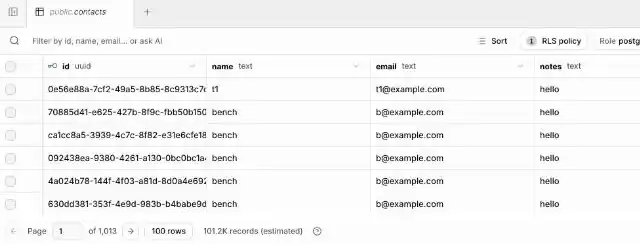
The Supabase contacts table after seeding: about 101,000 rows, with row-level security on.
Result 1: single request speed
| Request | PocketBase (same machine) | Supabase (over the internet) |
|---|---|---|
| Get one row by id | 0.79 ms | 228 ms |
| List 20 rows | 2.2 ms | 234 ms |
Median (p50). The PocketBase list was measured at about 300 rows; the Supabase list at 100,000 rows with an index. Supabase p95 was 247 ms (get by id) and 257 ms (list).
PocketBase looks about 300 times faster, but most of the Supabase time is the trip between the VPS and Supabase. The VPS is about 9 ms from Supabase's edge, and a request Supabase rejects at the edge (no API key) takes 40 to 55 ms. Requests that reach the database took about 230 ms. A Supabase project in Sydney gave a similar median (253 ms) to the Virginia one, so distance alone does not explain it, and we don't know the exact cause.
If your app server runs on the same box as PocketBase, database calls cost almost nothing. A hosted database is always a network call away.
Result 2: how much load each took
We raised the number of simultaneous connections step by step and watched for errors.
PocketBase (1 vCPU, load tool on the same CPU):
- Reading one row: about 3,800 requests a second at 50 connections, and 4,167 at 1,000 connections.
- Creating rows: about 2,300 to 2,600 requests a second.
- At 1,000 connections: 0 failed requests. Memory went from 123 MB to 317 MB.
- The CPU was fully used during the long run, so PocketBase's ceiling is somewhat higher than shown.
Supabase (free plan, Nano compute):
| Connections | Requests/s | Median latency |
|---|---|---|
| 1 | 2 | 319 ms |
| 50 | 153 | 301 ms |
| 200 | 548 | 311 ms |
| 400 | 663 | 532 ms |
| 800 | 806 | 936 ms |
- 0 failed requests and no throttling at every step, including 800 connections.
- Latency stayed flat up to about 200 connections, then began to climb. We stopped at 800.
- Creating rows: 194 requests a second at 50 connections.
Supabase throughput at low concurrency is low because each request waits about 300 ms, so one connection manages about 3 requests a second. More connections raise it, which is why throughput kept rising. On a single cheap server, PocketBase served more requests per second than Supabase's free plan, with no network in the way.
Result 3: the 100,000-row list problem (same on both)
Both databases slow down when a list is sorted and filtered on a big table.
PocketBase, 100,000 rows:
- A list of 20 took 60 ms by itself. With 25 users at once, it fell to 8.5 requests a second, with a median of 1.9 seconds and a p95 of 10.8 seconds.
- After adding an index on the created field and turning off PocketBase's total-count query (
skipTotal=1), the same list took about 1 ms, and 25 users at once got 1,311 requests a second.
Supabase, 100,000 rows:
- Without an index, 25 users at once got about 15 requests a second, median 1.35 seconds, p95 2.7 seconds.
- After adding an index on
created_at, the same test got 69 requests a second at 25 connections and 577 at 200 connections, with a median near 315 ms.
In both, getting one row by its ID stayed fast at every size. The fix for slow lists is the same: index the column you sort by. PocketBase also needs the total-count query turned off, because by default it counts the matching rows on every list call.
Login
PocketBase checks passwords with a deliberately slow hash. One sign-in took about 61 ms. With 10 people signing in at once, the median rose to about 594 ms, because they queue on the CPU. We did not test Supabase sign-in, since the free plan limits auth emails.
Realtime
On PocketBase, an update reached a subscribed client about 11 to 14 ms after the write started (this includes the write itself). We did not test Supabase real-time.
Server-side code
- PocketBase: JavaScript hooks in an embedded engine, or Go. Suited to validation, small tasks, and glue; heavy compute is better in a separate service.
- Supabase: Edge Functions on Deno, plus Postgres functions and triggers. We did not benchmark these.
Hosting and upkeep
| PocketBase | Supabase | |
|---|---|---|
| Who runs it | You | Supabase |
| Database | SQLite (embedded) | Postgres |
| Scaling | Bigger server only | Compute sizes, read replicas on paid plans |
| Backups and uptime | Yours to set up | Included on paid plans |
| Per-user data rules | API rules | Row level security |
| Free plan | Free software, you pay for the server | 500 MB, 50,000 MAU, pauses after a week idle |
| Stability | Pre-1.0, breaking changes possible | Hosted product |
How to choose
- A side project or small business tool you want to keep cheap: PocketBase.
- Your own server does the heavy lifting and sits next to the database: PocketBase.
- The app must stay up without you maintaining a server: Supabase.
- You want Postgres, or may outgrow one machine: Supabase.
- Front-end apps with per-user data: Supabase, because of row level security.
What to watch out for
- On PocketBase, plan your own backups and updates, and test upgrades before applying them.
- On both, index any column you sort or filter large lists by.
- On Supabase's free plan, a project idle for a week is paused.
Limits of our test
One run of each test, not repeated at different times of day. One small VPS. The PocketBase load tool shared the CPU with the server. Supabase was tested on the free plan's smallest compute, from one location. We used simple queries on a single table with open access rules. We did not test file uploads, Edge Functions, PocketBase's server-side hooks, or Supabase sign-in and realtime.
I'm Lourdes Paul Agilan, an indie maker and SEO consultant based in Chennai, India. I build small, focused software products and help B2B SaaS founders get found on Google and in AI answers. I like shipping fast, learning in public, and sharing what works along the way.